Cabo San Lucas: Two Economies, One Destination
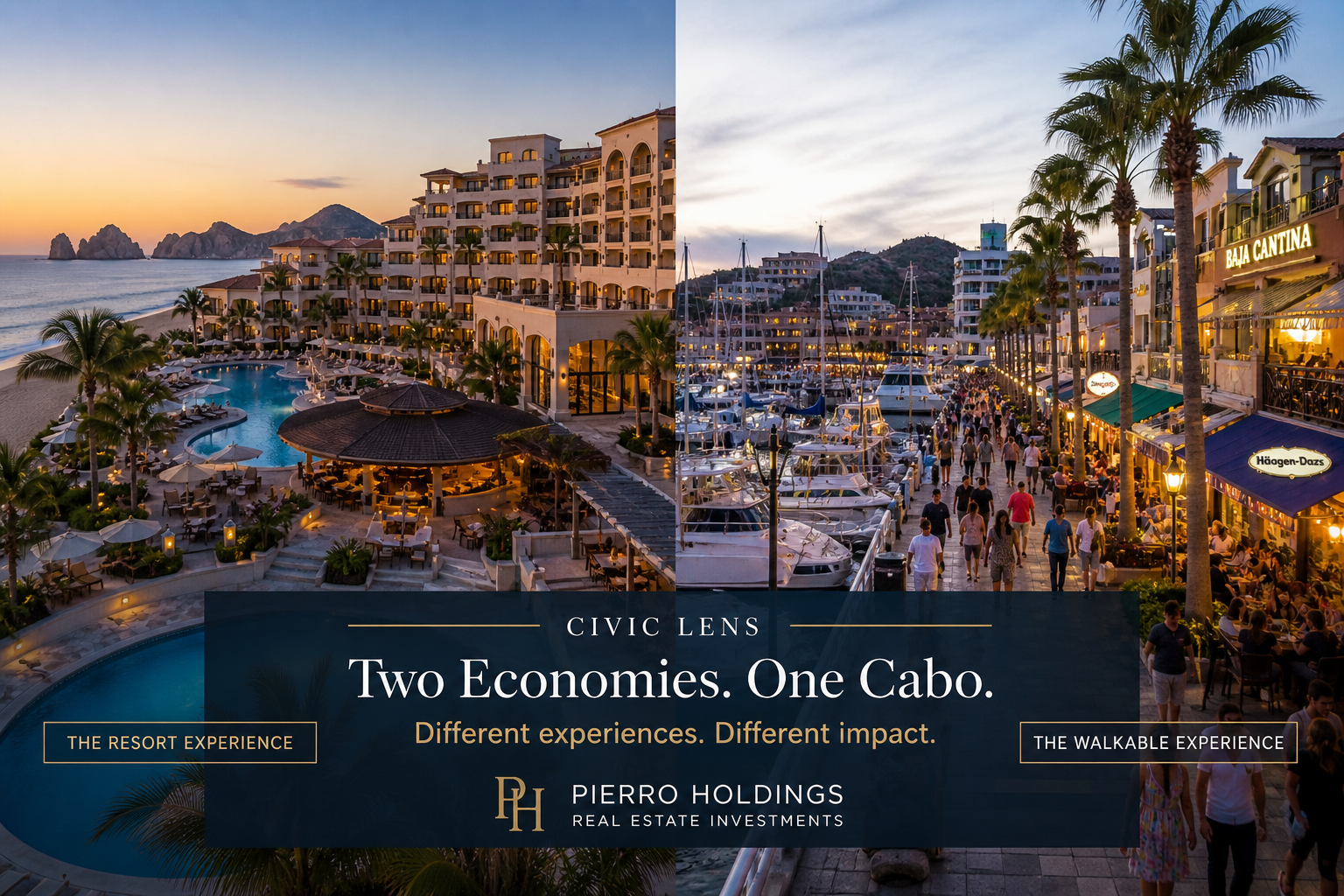
Cabo San Lucas is often described as a single destination, but in practice it operates as two.
Over the past decade, the region has evolved into parallel systems that shape how visitors experience the city — and how money moves through it. One is the resort economy: controlled, curated, and increasingly designed to keep guests within its boundaries. The other is what might be called the walkable economy: the marina, downtown streets, Medano Beach, and the network of restaurants, shops, and services that exist beyond resort gates.
Both are growing. But they function very differently.
The resort model is efficient by design. Guests arrive, check in, and are offered a complete experience without needing to leave. Dining, entertainment, and activities are packaged into the stay. From a business standpoint, this is a highly effective system — it captures revenue at nearly every touchpoint and creates a predictable, controlled environment.
In recent years, that model has intensified. Resorts have expanded their on-site offerings, investing in restaurants, beach clubs, wellness programs, and entertainment specifically to reduce the need for guests to go elsewhere. The strategy is clear: keep the experience contained, and keep the spending on property.
But Cabo did not grow from containment.
Long before the resort corridor expanded, the city was built around movement — between the marina, the beaches, and the neighborhoods that supported them. That pattern still exists, and it continues to define how a large segment of travelers experience the destination.
Around the marina today, the energy is different. Restaurants range from casual local spots to high-end dining with waterfront views. Retail has evolved, particularly around Puerto Paraiso, where shopping is increasingly tied to dining and social experience rather than simple transactions. Nightlife remains dense and active, and the marina itself continues to serve as a hub for charters, tours, and seasonal activities.
This is not a controlled environment. It's a network.
And importantly, it distributes economic activity in a way the resort model does not.
When a visitor stays inside a resort, most of their spending is captured by a single operator. When they move through the marina and downtown, that same spending spreads outward — across restaurants, small businesses, independent operators, and service providers who live and work in the community.
One system concentrates revenue. The other distributes it.
Neither is inherently wrong. But the difference matters, particularly as Cabo continues to grow and as pressures from development and rising property values reshape the city.
Gentrification in Cabo is not theoretical. It is visible — in housing costs, in shifting neighborhoods, and in the gradual displacement of the local workforce that built much of the city's tourism economy. In that context, how tourism dollars flow becomes more than a business question. It becomes a civic one.
The walkable economy plays a role here. It keeps visitors connected to the city, and it keeps spending connected to the people who operate within it. Restaurant owners, shopkeepers, tour operators, and service workers all participate directly when guests move beyond the walls of a single property.
There is also a difference in how these two systems shape the visitor experience.
Resorts offer consistency. They are designed to be predictable, seamless, and contained. For many travelers, that is exactly the goal.
The walkable model offers something else: variability. Guests choose where to go, what to eat, and how to spend their time. They interact with the city rather than observing it from within a managed environment.
That difference is increasingly reflected in traveler behavior.
A growing segment of visitors — particularly those using short-term rentals — are choosing access over containment. They are not looking to stay in one place. They are looking to move through many.
For property owners and investors, this shift has practical implications. Location is no longer just about proximity to the beach or views from a terrace. It is about how easily a guest can access the parts of Cabo they actually intend to use.
Properties within walking distance of the marina sit directly inside that system. They align with how independent travelers behave, and they benefit from the density of activity that already exists around them.
As Cabo continues to develop, both economies will persist. Resorts will keep expanding their contained experiences, and the walkable core will continue to evolve around the marina and downtown.
The question is not which one will win.
It is how each will shape the city — and who benefits as a result.
Walking distance from the Cabo San Lucas marina, Pedregal sits inside the walkable economy described above. See an active listing in this area →
© Pierro Holdings — Not to be copied or republished without permission.
Walking distance to the marina — inside the walkable economy described above.
The only lock-off unit in Pedregal Towers. Fully deeded, cash flowing, walkable to the marina — priced $100,000+ below every comparable unit in the building.