Cabo San Lucas: Prosperity Above, Pressure Below
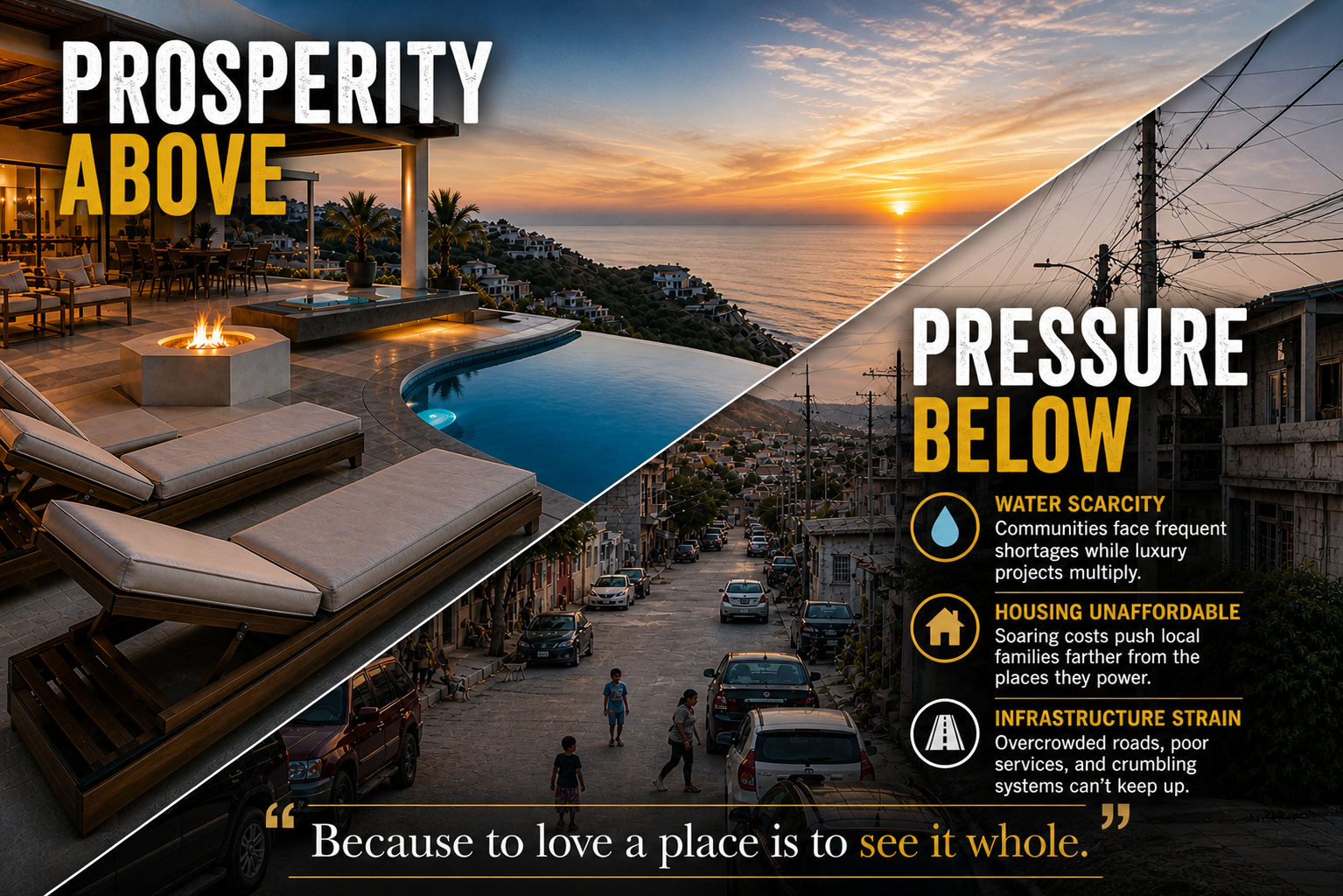
Cabo San Lucas is, by any visible measure, a success story.
In less than five decades, it has transformed from a small fishing village at the southern tip of Baja California Sur into one of the most visited destinations in the Western Hemisphere. The evidence is visible from nearly every vantage point: resort corridors stretching along the coastline, a marina filled with yachts, and an airport connected to major North American cities.
The numbers reinforce the narrative. Tourism revenue flows into the region at levels that would have been unimaginable to the families who lived here before the first resort was built. International capital continues to accelerate into luxury residential development, and well-managed short-term rental properties are producing returns that outperform comparable markets across North America.
The prosperity is real.
But it is not evenly distributed — and it is not self-sustaining.
Beneath the visible economy — beneath the resorts, the marina, and the residential towers rising across the hillsides — a different reality is taking shape.
The systems that support Cabo's growth are not the ones most visitors see. They are the water networks that strain under demand, the roads connecting inland colonias to the tourist corridor, the housing stock available to the workforce, and the municipal services required to keep the city operating.
These systems exist on a different timeline than the investment that built Cabo's visible success.
And that difference defines how the city actually functions.
Cabo's development follows a pattern that is familiar across global resort markets.
Capital arrives first, driven by demand for destination real estate and tourism revenue. Development follows, focused on assets that generate measurable returns — hotels, resorts, and residential properties positioned for short-term rental income.
The supporting systems — housing, infrastructure, and municipal capacity — expand more slowly, often under different funding structures and priorities.
The result is not necessarily a failure of planning. It is a structural outcome of how capital is deployed.
Returns are measured in occupancy, yield, and appreciation. They are not measured in commute times, water reliability, or the cost of living for the workforce that supports the system.
Over time, the effects become visible.
As property values rise near the tourist corridor, workers move further inland to find affordable housing. Commute times increase. The cost of maintaining the system rises — not only in financial terms, but in the physical and operational strain placed on the workforce and the infrastructure itself.
In more mature markets, this pattern becomes more pronounced. The culture that originally defined the destination begins to shift. It is preserved in appearance, but less present in daily life. Areas that once supported a balanced community become increasingly specialized — serving the tourism economy without fully participating in its benefits.
These outcomes are not unique to Cabo. They have been documented in markets such as Hawaii, the Riviera Maya, the Algarve, and Tulum. In each case, rapid capital inflow and accelerated development outpaced investment in foundational systems.
Cabo has not reached that endpoint.
But the trajectory is visible.
For investors, this creates a gap between how the market is typically evaluated and how it actually operates.
The standard framework is well established: title security, rental performance, market growth, and HOA stability. These are necessary considerations, and they remain valid.
What is less frequently examined is the dependency behind those metrics.
The performance of a rental property in Cabo depends not only on demand, but on the reliability of the systems that support it — the availability of labor, the functionality of infrastructure, and the capacity of the city to sustain its own growth.
These factors are rarely modeled.
But they influence outcomes over time.
This is not an argument against Cabo.
The opportunity is real. The growth is real. The returns can be real.
It is an argument for understanding the full system in which those returns are generated.
Because prosperity, when concentrated in visible assets, places pressure on the systems beneath them.
And over time, that pressure reshapes the market itself.
A more complete question for investors is not simply whether Cabo is growing, but what that growth depends on — and whether those dependencies are being maintained.
What would Cabo look like today if the same level of investment that built its visible success had also been directed consistently toward its foundational systems?
There is no clear answer.
But the gap between what was built above and what was built beneath remains central to how Cabo operates today.
The purpose of this Civic Lens series is not to critique or to promote.
It is to document both sides of that reality with clarity.
Because to understand a place, you have to see both.
And to invest in a place responsibly, you should.
© 2025 Richard Pierro · Pierro Holdings LLC · All rights reserved.
This article may not be reproduced, copied, or distributed without written permission from the author. Contact: info@pierrollc.com
The property that solves exactly what this article describes.
The only lock-off unit in Pedregal Towers. Fully deeded, cash flowing, walkable to the marina — priced $100,000+ below every comparable unit in the building.