Civic Lens No. 2
From the air, Cabo San Lucas looks like a destination perfected.
The topography is dramatic — the granite formations at Land's End, the turquoise arc of the Sea of Cortez meeting the Pacific, the golden hillsides rising steeply behind the marina. From altitude, the development reads as an extension of the landscape's own drama: white towers catching the morning light, terraced pools that mirror the ocean below them, the marina basin ringed with restaurants and yachts in quiet motion. It looks, from above, like the logical conclusion of a beautiful place.
The water trucks arrive before sunrise.
On the residential streets of the colonias — the neighborhoods where the people who run Cabo's resort economy actually live — municipal water service is intermittent at best. Many households have no running water on a reliable daily schedule. The infrastructure for municipal water delivery has not kept pace with the city's decades of accelerating growth. Homes and businesses supplement or replace municipal supply with pipas: private water trucks that deliver to rooftop storage tanks called tinacos.
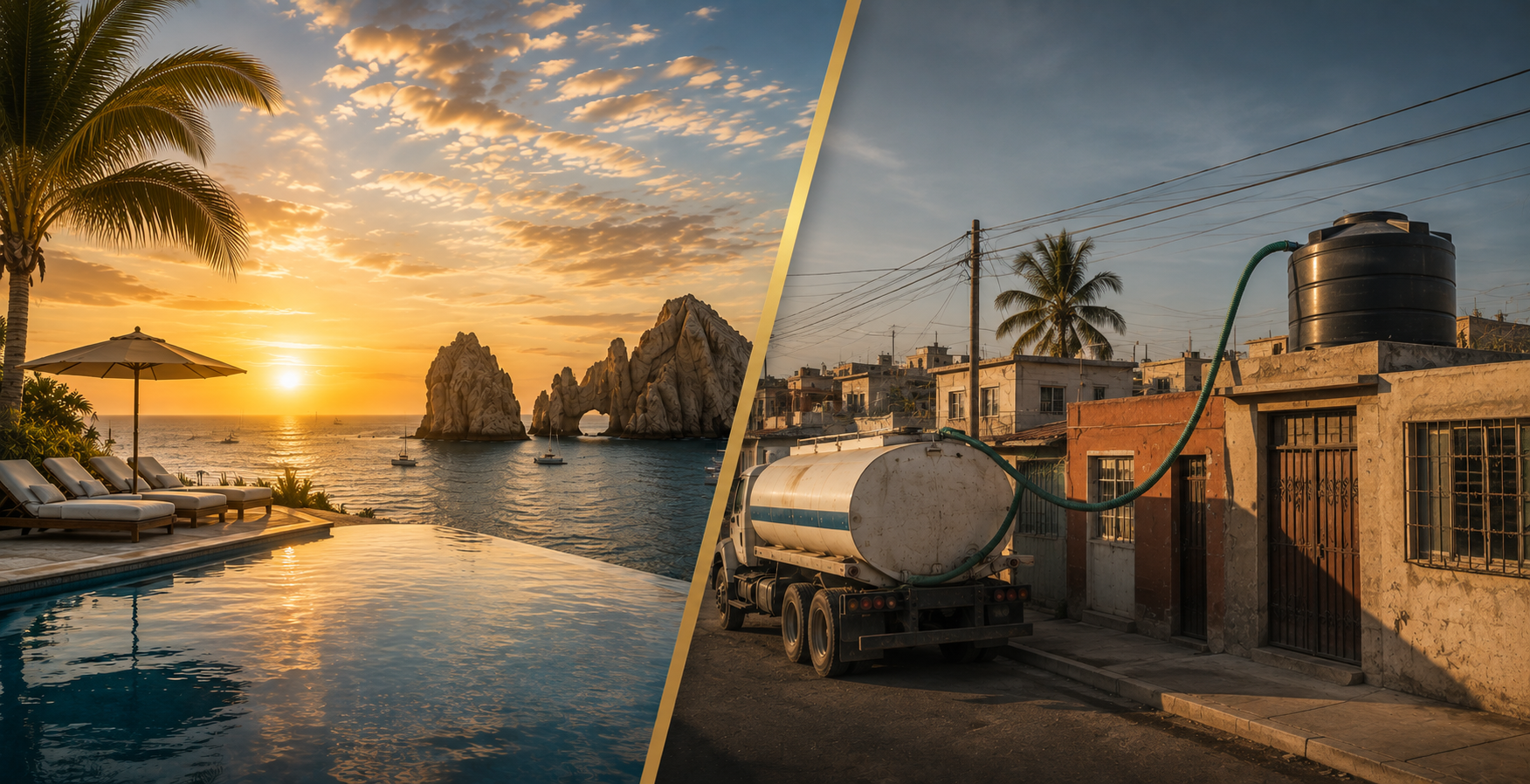
It is not a crisis in the way that word is typically deployed. People manage. They have built their lives and their routines around it. The tinacos are part of the architecture of the colonias the way that the infinity pools are part of the architecture of the hotel zone.
But the distance between those two architectures — the pool and the tinaco — is the central fact of Cabo's infrastructure divide.
The word that surfaces most often in conversations about this divide is desigualdad — inequality. But that framing, while accurate, is incomplete. What exists in Cabo is not simply inequality of outcome. It is inequality of infrastructure investment — a structural gap between what the tourism economy built for itself and what it left unresolved for the communities that make it function.
The resort corridors have reliable power. They have water systems capable of filling rooftop pools above a Pacific view. They have sewage treatment sufficient for international hospitality standards. They have industrial-grade air conditioning running continuously through the Baja summer. The investment in their physical infrastructure was part of the investment in the resort product itself — because you cannot sell a luxury experience without the systems that deliver it.
The colonias received a different level of investment, on a different timeline, from different sources.
"A luxury bubble floating over municipal neglect — not as condemnation, but as reflection of uneven development timing."
This is the structural reality. It is not unique to Cabo. The same pattern appears in Tulum. In Playa del Carmen. In the Riviera Nayarit. In every Mexican coastal destination that scaled rapidly on the back of international tourism capital. The investment in the visible — the resorts, the restaurants, the marinas — has consistently outpaced investment in the invisible: the pipes, the treatment plants, the road extensions into neighborhoods that don't appear in the marketing materials.
The tinaco sits on the roof of a house in a colonia on the inland side of the highway. The family that owns the house has lived there for three generations. They track the tank level the way their neighbors in the hotel zone monitor the pool chemistry — daily, attentively, with the understanding that the system requires active management.
When the pipa comes, they fill the tank. When the pipa doesn't — because demand is high, or the schedule has shifted — they manage with what they have stored. They live with water in a way that visitors to Cabo's resort corridor never will.
"Visitors swim in rooftop infinity pools overlooking the Pacific… while local families monitor stored tank levels to manage daily needs."
Both things are true simultaneously. And both things are Cabo.
The question this divide raises is not whether Cabo should stop developing. Development is happening and will continue. The capital is committed. The projects are in the ground. The international investment in this market will not reverse.
The question is whether the next cycle of development — the one happening right now, the towers going up on the hillsides, the new hotel projects breaking ground along the corridor — can be structured to include the foundational infrastructure that the previous cycles deferred.
Some things are changing. State and municipal governments have identified infrastructure investment as a priority. New water treatment capacity is under construction. Some larger development approvals have included colonia infrastructure components as conditions. The trajectory is not entirely static.
But the gap is large. And the pace of development continues to outrun the pace of repair.
What does this mean for the investor buying into this market?
It means understanding that the investment is embedded in a city with two very different operating realities. The resort economy will continue to perform. The Baja climate will continue to draw visitors. The yields on well-managed properties in the right corridors are real.
But the city that makes all of this possible is running infrastructure that was not built for what it is being asked to handle. The housekeepers, the maintenance workers, the restaurant staff — the people on whom the entire resort economy depends — many of them travel from colonias where water truck scheduling is a daily management task.
This is not a reason to not invest here. It is a reason to invest with clear eyes.
"Because to understand a destination… you must see both the infinity pools… and the water trucks."
The full picture. The complete story. The place as it actually exists, not only as it appears from altitude — from the plane descending into SJD, from the marketing materials, from the postcard.
Cabo is a place of genuine, extraordinary beauty. It is also a place navigating the weight of its own success. Both of those things are true. And both of those things are worth understanding before you invest in it, or live in it, or write about it, or simply visit and call it paradise.
© 2025 Richard Pierro · Pierro Holdings LLC · All rights reserved.
This article may not be reproduced, copied, or distributed without written permission from the author. Contact: info@pierrollc.com
The property that solves exactly what this article describes.
The only lock-off unit in Pedregal Towers. Fully deeded, cash flowing, walkable to the marina — priced $100,000+ below every comparable unit in the building.